When stress does not turn off, your body may show it through stomach discomfort, poor sleep, racing thoughts, muscle tension, irritability, or the feeling that you can never fully relax.
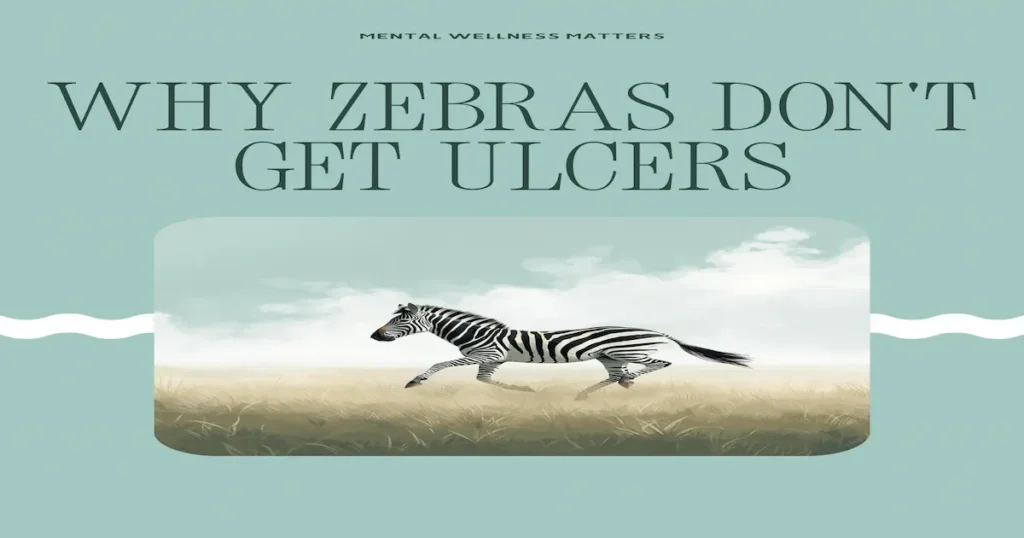
Imagine a zebra grazing peacefully in the savanna. Suddenly, a lion appears. The zebra’s body immediately goes into survival mode: heart pounding, muscles tensing, ready to run.
But once the danger passes, the zebra does not keep replaying what happened. It does not start worrying about when the next lion might appear. Its body slowly returns to a more relaxed state, and it goes back to grazing.
Humans are different.
We do not only feel stress when danger is happening. We worry before something happens. We replay what happened after it is over. We imagine worst-case scenarios. Sometimes, the stress leading up to something feels worse than the event itself.
Stress does not only live in the mind. When we feel stressed or anxious, the body responds too.
The stress response is meant to protect us. It helps us become more alert, focused, and ready to deal with danger. In the short term, this response can be useful.
But when stress becomes ongoing and the body does not get enough time to return to rest, you may start noticing signs such as:
If you often feel anxious, tense, or physically uncomfortable, it does not mean you are weak. It may mean your body has been carrying stress for too long.
A gentle note: stomach pain, ulcers, reflux, or other physical symptoms can also be related to diet, medication, H. pylori infection, or other medical factors. If symptoms continue or worsen, it is important to speak with a family doctor or medical professional. Counselling can support the stress and emotional side, but it does not replace medical assessment.
The human brain is very good at predicting danger. This helped us survive by preparing for risk before it arrived.
In modern life, the “lion” is often not an actual predator. It may be work pressure, relationship stress, family expectations, money worries, health concerns, social situations, or uncertainty about the future.
You may notice thoughts like:
Even when nothing dangerous is happening in the moment, your body may already be responding as if there is a threat: faster heartbeat, tight stomach, tense shoulders, shallow breathing, or trouble sleeping.
If you have lived through chronic stress, relationship hurt, family conflict, an accident, loss, or experiences where you did not feel safe, your nervous system may become more sensitive to possible threat.
Sometimes a present situation reminds your body of a past experience, even if you do not consciously connect the two. Your body may move into protection before you have time to think it through.
Stress or trauma responses can look like:
These responses do not mean something is wrong with you. Often, they are protective strategies your body learned when it was trying to help you survive or stay connected.
Counselling is not about forcing yourself to “think positive” or simply telling yourself to stop worrying.
For many people, counselling offers a space to slow down and understand what is happening underneath the stress. Why does your body feel so tense? Why does your mind keep racing? Why do you still feel unsettled even after the situation has passed?
In stress and anxiety counselling, we may explore:
If you are dealing with ongoing stress, anxiety, overthinking, or body tension, you can read more about stress and anxiety counselling.
If your stress is connected to relationships, family, work, self-worth, identity, grief, or past experiences, individual counselling can also help you understand your emotions, patterns, and needs more clearly.
We cannot remove stress from life completely. But we can slowly learn how to notice when the body has moved into survival mode, and how to help ourselves return to the present.
The next time you notice your heart racing, stomach tightening, sleep becoming lighter, or thoughts looping again and again, you do not have to blame yourself.
You might gently ask:
This question may not fix everything at once, but it can help you begin a different relationship with your body and stress response.
Stress activates the body’s survival response, which can affect digestion, muscle tension, sleep, and alertness. Some people notice stomach tightness, stomach pain, reflux, bloating, or changes in appetite when stress is high. If digestive symptoms continue, it is important to speak with a medical professional as well.
Not always. Anxiety often involves both the mind and the body. Your brain may be trying to predict danger, while your body prepares to protect you. Counselling can help you understand the patterns underneath anxiety instead of simply telling yourself to stop thinking.
Counselling can help you understand the connection between stress, emotions, and body responses. It may support you in noticing triggers, working with emotions differently, and building gentler ways to care for your nervous system. If you have strong physical symptoms, it is also important to seek medical advice.
You may consider counselling if stress, worry, poor sleep, overthinking, body tension, irritability, avoidance, or feeling constantly overwhelmed is affecting your daily life, relationships, work, or sense of well-being.
Love Heals Counselling offers in-person counselling in Vancouver and online counselling across BC. Services include individual counselling, stress and anxiety counselling, relationship counselling, and family counselling in English and Mandarin.
If you often feel tense, anxious, unable to relax, or physically uncomfortable from stress, counselling can offer a safe space to slow down, understand what your body has been carrying, and begin finding a different way forward.
Love Heals Counselling offers in-person counselling in Vancouver and online counselling across BC in English and Mandarin.
You can learn more about stress and anxiety counselling or individual counselling.
I live and work on the traditional, ancestral, and unceded territories of the xwməθkwəy̓əm (Musqueam), Skwxwú7mesh (Squamish), and səlil̓ilw̓ətaʔɬ (Tsleil-Waututh) Nations.
Love Heals Counselling and Consulting © 2026. All Rights Reserved.

We use essential cookies to make this website work and optional cookies to understand how visitors use the site. You can accept, reject, or manage your preferences at any time.
我們使用必要 Cookie 讓網站正常運作,並使用選用 Cookie 了解訪客如何使用本網站。您可以隨時接受、拒絕,或管理您的偏好設定。