Anxiety, stress, and emotional exhaustion
Learning to Let Go and Ease Anxiety, Stress, and Emotional Exhaustion
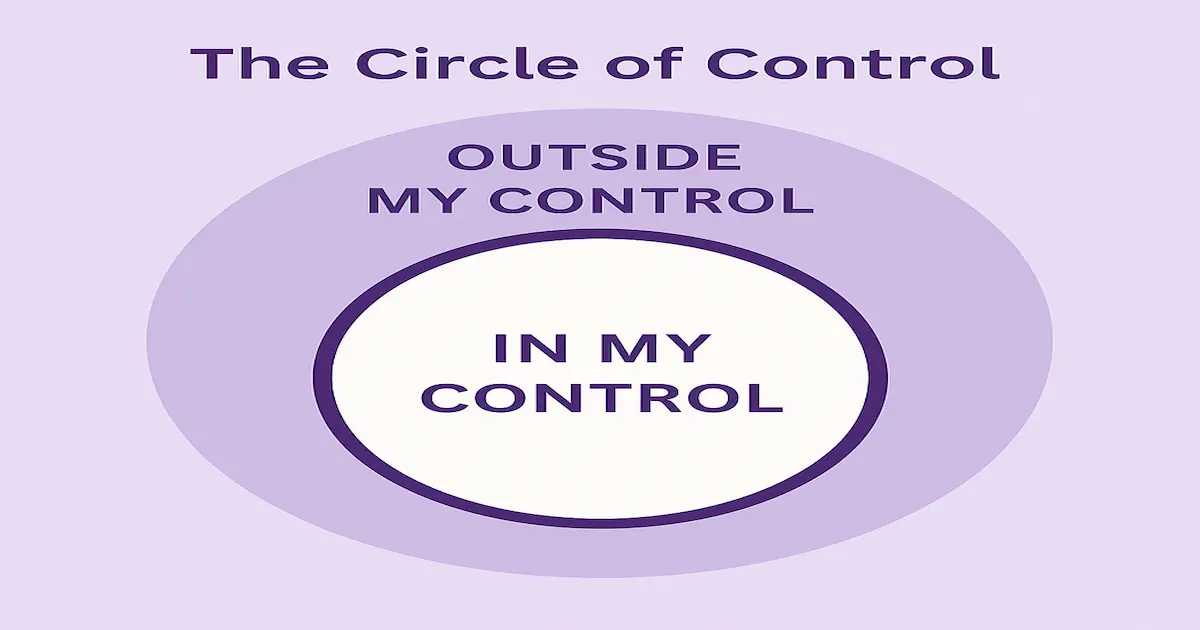
When you feel responsible for everything, your mind and body can stay in a constant state of pressure. The Circle of Control can help you gently notice what is yours to carry, what you can influence, and what may need to be released.
Many clients who come to counselling tell me they feel like they have to “hold everything together” — their family’s emotions, the direction of a relationship, their performance at work, plans for the future, and even how other people see them.
When something does not go as planned, the mind can quickly turn inward:
- “Maybe I didn’t do enough.”
- “If I had tried harder, maybe things would be different.”
- “Maybe this is my fault.”
Over time, this kind of self-blame can become exhausting. Your body may feel tense, your mind may keep spinning, and you may feel responsible for things that were never fully yours to carry.
The Circle of Control is a simple but powerful idea that can help you sort through anxiety, stress, guilt, and emotional overwhelm. It helps you notice what is actually within your control, what you can influence, and what you may need to slowly release.
If anxiety, overthinking, or constant pressure has been affecting your daily life, you may also find support through stress and anxiety counselling in Vancouver or individual counselling.
What Is the Circle of Control?
The Circle of Control helps us separate life into three areas:
- What I can control
- What I can influence
- What I cannot control
This may sound simple, but for people who feel anxious, responsible for others, or emotionally overwhelmed, this distinction can be very healing. It reminds us that not everything painful is ours to fix, manage, or carry alone.
1. Inner Circle: What I Can Control
This is where your real choices and agency live. For example, you may not be able to control how someone reacts, but you can pay attention to how you respond, what you need, and what kind of care you offer yourself.
Things within your control may include:
- The choices and decisions you make
- How you respond to stress, anxiety, or difficult emotions
- Whether you speak up about your needs and boundaries
- The way you communicate
- How you care for your physical and emotional well-being
- Your values and the direction you want your life to move toward
Bringing your attention back to this inner circle can help you feel more grounded. Instead of being completely pulled around by other people’s emotions or outside circumstances, you can begin to reconnect with what is still available to you.
2. Middle Circle: What I Can Influence but Not Fully Decide
Some areas of life are important to us, but they are not fully within our control. We can show up, try, communicate, repair, and care — but we cannot guarantee the outcome.
Things you may be able to influence include:
- The tone of a conversation
- How safe or respectful you try to make an interaction
- Whether you invite your partner or family member into a more honest conversation
- How you participate in family or relationship patterns
- How you collaborate with people at work
- Whether you express your needs clearly and respectfully
You can influence these areas, but you cannot control another person’s readiness, response, or willingness to change. This is where many people become stuck: trying harder and harder to create a result that depends on more than one person.
3. Outer Circle: What I Cannot Control
The outer circle includes things that are outside your control, even if they affect you deeply.
- Other people’s thoughts, emotions, and behaviours
- Things that have already happened in the past
- Whether others fully understand you
- Whether someone approves of your choices
- When another person is ready to apologize, reflect, or change
- Family expectations that were shaped long before you had a voice
- Economic, political, or social changes
- The pace of someone else’s healing
When we pour too much energy into the outer circle, anxiety often increases. The body stays tense because it keeps trying to solve something that cannot be solved through effort alone.
Why Trying to Control Everything Can Increase Anxiety
Anxiety often becomes stronger when the mind believes everything is urgent, everything is personal, and everything depends on you. You may feel like you have to predict every outcome, prevent every conflict, and protect everyone from disappointment.
This can create a painful cycle:
- You feel uncertain or unsafe
- You try to control more details
- You become more tense and exhausted
- Things still do not fully go the way you hoped
- You blame yourself and try even harder
This is why learning to identify your circle of control can be an important part of anxiety and stress counselling. The goal is not to stop caring. The goal is to stop carrying what was never fully yours.
Control, Self-Blame, and Emotional Exhaustion
When people feel they do not have enough control, they do not always become more relaxed. Sometimes they actually blame themselves more.
You may notice thoughts like:
- “It must be because I’m not good enough.”
- “If I tried harder, this would not have happened.”
- “Things turned out this way because of me.”
- “I should have known better.”
This kind of self-blame can feel like responsibility, but it often becomes a heavy emotional burden. Instead of helping you move forward, it keeps you stuck in guilt, overthinking, and shame.
In individual counselling, we can gently explore where this self-blame came from, what it has helped you survive, and how to build a kinder relationship with yourself.
Why This Can Feel Especially Heavy in Chinese and Immigrant Families
For many people from Chinese, Asian, or immigrant families, responsibility is not only personal. It is relational and cultural.
You may have grown up hearing messages like:
- “Be sensible.”
- “Don’t embarrass the family.”
- “Work harder.”
- “Don’t trouble others.”
- “As long as the family is okay, you can endure it.”
These messages can teach you to notice other people’s needs before your own. You may become very good at reading the room, preventing conflict, and taking responsibility for other people’s emotions.
This is not a personal flaw. It may have been a survival strategy that helped you belong, stay connected, or avoid conflict. But as you grow older, the same pattern can become painful. You may start to feel like there is no room for your own emotions, choices, boundaries, or needs.
How the Circle of Control Can Help Reduce Stress
1. It Helps You Notice What Is Yours and What Is Not Yours
When everything feels like your responsibility, the nervous system stays on alert. The Circle of Control helps you pause and ask: “Is this actually mine to solve?”
That question alone can create breathing room.
2. It Helps Reduce Overthinking
Overthinking often happens when the mind keeps trying to control an outcome that is uncertain. When you can name what is outside your control, you may still feel sadness, disappointment, or fear — but you do not have to keep mentally rehearsing every possible scenario.
3. It Helps You Use Your Energy More Effectively
Instead of spending all your energy trying to change someone else’s reaction, you can bring your attention back to what is possible: your next step, your boundaries, your communication, your rest, your support system, and your values.
4. It Builds Self-Compassion
When you realize that not everything was within your control, you may begin to soften toward yourself. You can still take responsibility where it belongs, but without blaming yourself for every outcome.
A Small Practice: What Can I Control Right Now?
The next time you feel overwhelmed, anxious, or emotionally flooded, you can gently ask yourself:
“Is this something I can control, something I can influence, or something that is not in my hands?”
Then try this:
- If it is outside your control, practice slowly loosening your grip.
- If it is something you can influence, express yourself clearly and respectfully.
- If it is within your control, choose one small next step.
This does not mean you will suddenly stop caring. It means you are learning to care without abandoning yourself.
When Counselling Can Help
If you often feel responsible for everyone, find it hard to say no, blame yourself easily, or feel guilty when you choose yourself, these feelings deserve care and attention.
In a gentle, culturally sensitive, LGBTQ+-affirming counselling space, we can work together to:
- Understand why self-blame and guilt show up so easily
- Practice boundaries without disconnecting from your values
- Explore family roles, cultural expectations, and relationship patterns
- Build emotional regulation and self-compassion
- Reconnect with your own needs, choices, and sense of direction
You do not need to have the perfect words before starting counselling. If you only know that you feel tired, anxious, overwhelmed, or responsible for too much, that is enough of a starting point.
You can learn more about individual counselling in Vancouver and online across BC, or explore support for stress and anxiety counselling.
Frequently Asked Questions
Can the Circle of Control help with anxiety?
Yes. The Circle of Control can help reduce anxiety by helping you separate what you can control from what you cannot. This can make it easier to stop overthinking, reduce self-blame, and focus on one realistic next step.
Why do I blame myself for things I cannot control?
Self-blame can develop when you learned to feel responsible for keeping peace, meeting expectations, or protecting relationships. In some families or cultures, taking responsibility for others may have been encouraged, even when the situation was not fully within your control.
How can counselling help with stress and self-blame?
Counselling can help you understand where stress and self-blame come from, recognize emotional and relationship patterns, practice boundaries, and build a kinder relationship with yourself. It can also support anxiety, overthinking, family stress, relationship stress, and emotional exhaustion.
Do I need to know exactly what is wrong before booking counselling?
No. Many people start counselling simply because they feel overwhelmed, stuck, anxious, or tired of carrying everything alone. You do not need to have everything figured out before reaching out.
Book a Free Consultation
If you are feeling overwhelmed by anxiety, stress, guilt, or self-blame, you are warmly invited to book a free 20-minute consultation. Counselling is available in Vancouver and online across BC.